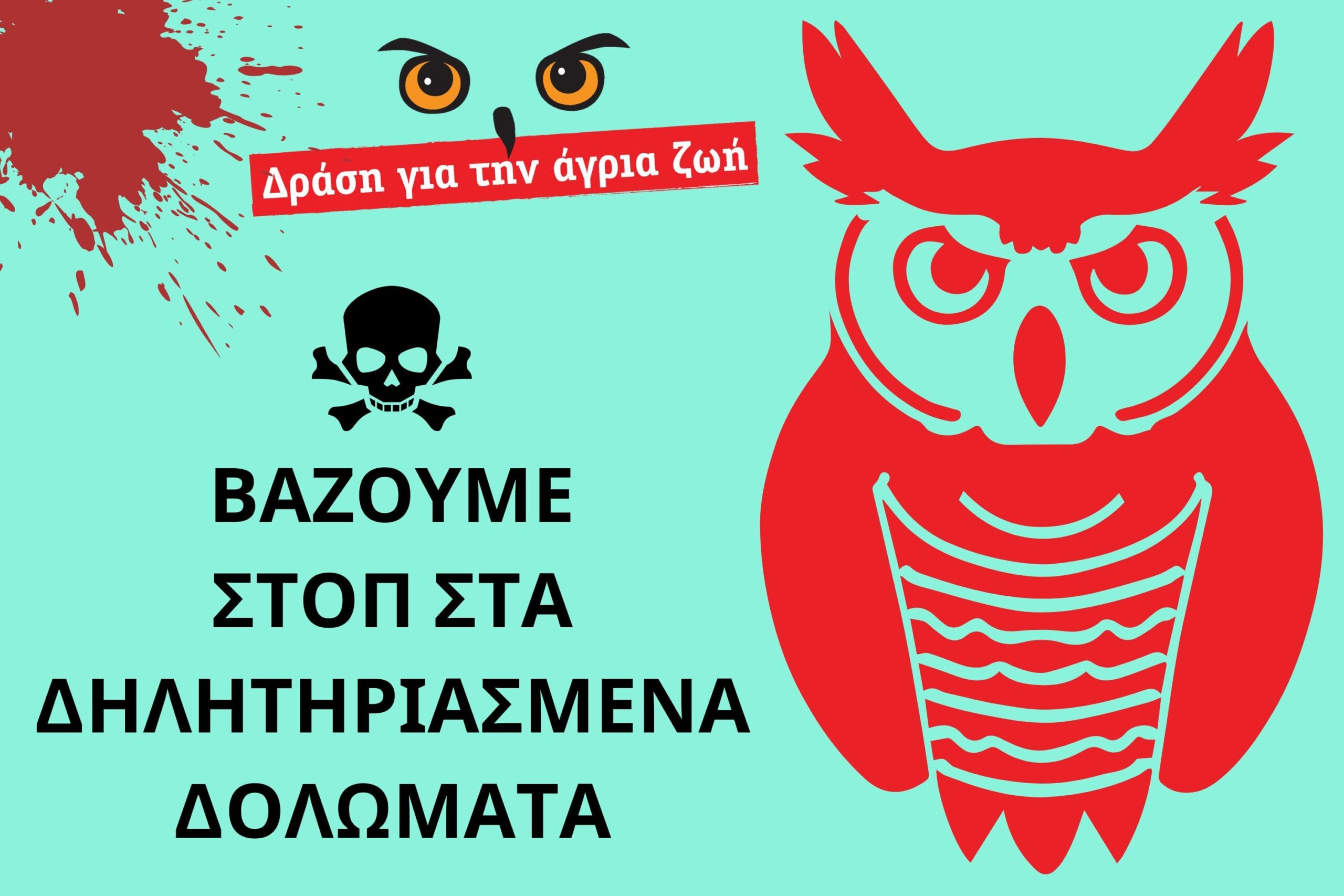
While the efforts of scientists and volunteers across Greece to rescue injured and sick wild animals continue unabated, the crime of using poisoned baits still exists.
The Natural Environment and Climate Change Agency issued a statement according to which, in total, 48 wild animals lost their lives in a tragic and painful way from poisoned baits.
The announcement states the following:
New incident of mass poisoning of wildlife in Evros National Park with 48 dead animals
A chain of wildlife deaths has unfolded once again in the Evros region, and this time within the boundaries of the Evros Delta National Park! One year after the incident that caused the death of 47 wild animals in the area of Feres, Evros, once again this year, just a few kilometers away, dozens more animals met a horrific death, likely from poisoned baits. Specifically, after several days of investigations with the assistance of two Special Poisoned Bait Detection Units, a total of 48 dead animals were found, marking a new negative record for the country’s statistics.
It all began on Wednesday, March 12, 2025, when members of the staff of the Evros Delta and Dadia National Parks Management Unit noticed that the telemetry transmitter placed on a Marsh Harrier (Circus aeruginosus) had been emitting from a fixed location for an extended period. The following day, after an on-site inspection of the area where the transmitter was signaling, two dead Marsh Harriers were found, one of which was carrying the transmitter.
The incident was immediately reported to the Alexandroupolis Forest Service and the Thrace Biodiversity Protection Society (EPBTh). During joint patrols carried out with the participation of the EPBTh's Special Poisoned Bait Detection Unit and the Protected Areas Management Unit of Central Macedonia from the Hellenic Ministry of Environment and Energy (OFYPEKA), in the following days until Tuesday, March 18, the dead animals were located and collected in close proximity to the site. Additionally, a suspected poisoned bait (a carcass of a livestock animal with a suspicious substance) was found. The animals discovered included 16 Jackals, 13 Marsh Harriers, 16 Buzzards, as well as one Crow and two Ravens.
During the six days of patrols, approximately 50 kilometers were covered by the two dogs, Dalton and Bora, and their handlers. All the dead animals were collected by the Alexandroupolis Forest Service and safely buried, with the assistance of the Municipality of Alexandroupolis, to prevent further poisoning of animals. Additionally, samples were taken from the suspected poisoned bait and the findings that were in good condition were sent to the Evros Veterinary Directorate for toxicological analysis.
Read the full Press Release here.
As an organization that works daily for the care, rescue, and rehabilitation of wildlife into their natural habitat, we condemn and denounce such despicable actions. We hope that the perpetrators will be identified and apprehended soon, so they can be punished severely for their criminal acts.
Beyond the tragedy of the situation, it is important to know how to react if we find a dead animal in the countryside, especially if there are signs of poisoning. The following are the basic instructions as recorded on the OFYPEKA website:
What should I do when…
…I find a poison bait or poisoned animal in the countryside
- Do not touch it and keep a safe distance!
- If I have pets or children around me, I keep them under close surveillance, so they won’t touch anything or eat any poisoned baits still left in the area.
- Take some photos.
- If possible, call at 1591 (Forestry Service), 100 (Police) or, if I am in a protected area, at the local NECCA Management Bodyν and give as many details as possible, regarding the exact location of the incident.
- If possible, I remain at the spot until the authorities arrive.
- If I find a poisoned animal, which is still alive in the countryside, call one of the following Animal Rescue Centres for further guidance:
- ANIMA – Hellenic Wildlife Care Association Athens: 210 9510075 & 697 266 4675
- Action for Wildlife,
Thessaloniki: 697 991 4852- Alkyoni Aegean Wildlife Hospital
Paros: 22840 22931, 6944 741616- KEPAZ Centre for Wildlife Protection and Care
Pyrgos (Trifylia), Peloponnese: 6985 620111 & 27630 41446- Naxos Wildlife Protection,
Naxos: 697 6797070…I hear that someone has used poisoned baits in the countryside
- I call at 1591 (Forestry Service), 100 (Police) or, if I am in a protected area, at the local NECCA Management Body. I give as many details as possible, regarding the exact location of the incident.
- I express my disapproval of this action among the other members of my community and inform and discuss for alternative possible ways to solve any potential drivers behind this practice, which are safe and legal, such as alternative preventive measures and tools and requests to competent authorities to implement more intensive surveillance of hot-spots/places with frequent occurrence of poisoned baits.
More information can be found here.